Chrome Yellow

chromeYellow
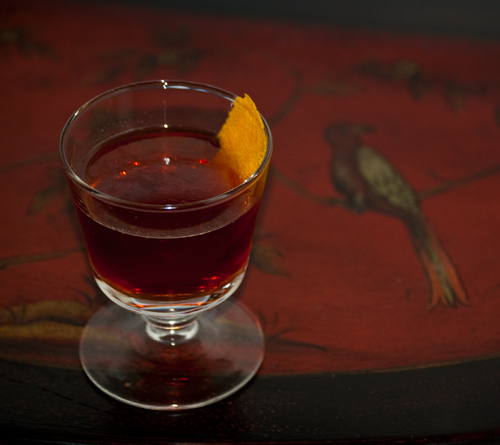
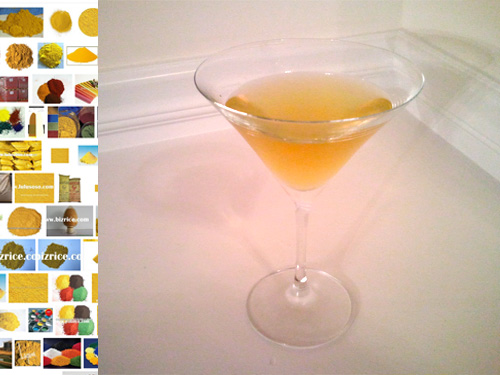
So at this point in my Sunday in the Park cocktails I realized I was getting to the end of my friendly oranges and yellows and I hadn’t yet used a nice aged whiskey. I had utilized a silver whiskey for my first drink, the Vermillion, but hadn’t gone with a whiskey with any color, which I knew wouldn’t be possible once I moved into blues and greens. So I turned to bourbon for the basis of my sour variation, the Chrome Yellow (let’s say something like #FCDE28 though I was going for more of something you would see on a school bus).

Chrome Yellow

  • 1.5 oz. Bourbon
  • 0.5 oz. Gran Classico
  • 0.5 oz. St. Germain
  • 0.25 oz. lemon juice

Shake with ice and strain into cocktail glass.
Twist lemon peel over glass and discard.

I am not the biggest fan of lemon juice, as I have written, but there was enough sweetness here to counter it for me. The Gran Classico added a bitterness to the sweetness from the floral St. Germain (in addition to its own sweetness and what you get from the bourbon). It also added just the right color, which, you know, is sort of the theme here.

Interestingly to me, chrome yellow was an unfortunate choice for Seurat (and others). It oxidizes and dulls over time and a fair bit of brilliance in the original La Grande Jatte painting is gone because of it, replaced by muddier browns where the more vibrant chrome yellow once was.

That’s a lesson to everyone to fresh squeeze their lemons for their drinks. I think. I’m not good at extracting morals.

Cadmium Yellow

cadmiumYellow

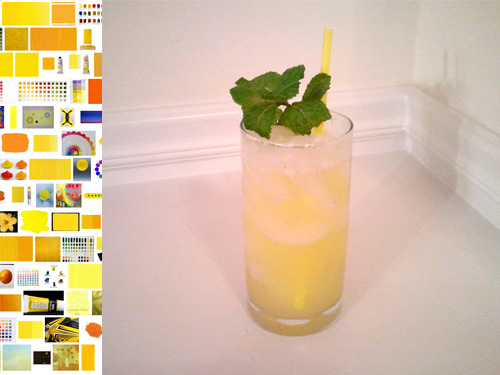
While I was initially posting these cocktails for Sunday in the Park with George for my friends I was called out for unintentionally teasing those unable to partake due to age or to a little human growing inside of them. My wife does not drink, so occasionally I try to put together something unique and tasty for the teetotaler. It seemed only fair to have at least one color within Seurat’s palette inspire a nonalcoholic beverage.

Cadmium Yellow

  • 3.0 oz. pineapple juice
  • 1.0 tsp cream of coconut
  • 1 barspoon ginger rice vinegar
  • 4 dashes Fee Brothers’ Celery bitters
  • 1 pinch celery salt
  • 4.0 oz. Q Ginger Ale

Shake all but ginger ale with ice and strain into highball over ice.
Top with ginger ale and garnish with a mint sprig.

Cadmium yellow is a bright and vibrant pigment (hex value of #FFF500, which is too bright to color this text with over a white background) that seemed to just call for pineapple juice as a base. Coconut of course pairs nicely with that. At that point I just started to have fun, reaching for a ginger rice vinegar I had recently picked up that I thought would cut into the sweetness of the pineapple and coconut nicely and seemed to be pushing me into a Thai direction. Thus, although I know it sounds a bit odd (and scared some of my castmates as I was mixing), I added in the celery elements. I love adding pinches of salt or saltwater to drinks, and the celery salt with the celery bitters really took the drink in an interesting direction. I topped it all off with some Q ginger ale (you can use another, but I personally favor Q) and some mint for a nice aromatic finish. Generally I don’t go for highballs or drinks topped with soda (sugary or not) as I tend to find these dominate over the liquor. However, in a drink without liquor and with such a strong, flavorful base, the ginger ale was a welcome finish.

Iron Oxide Yellow

Iron Oxide Yellow cocktail
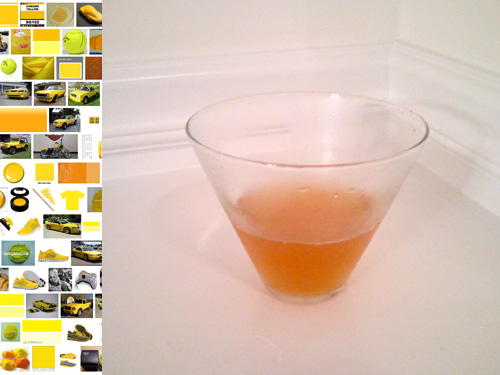
Now for Cocktails in the Park with George (or Sunday in the Park with Cocktails — take your pick) we move out of the red/brown pigments that were on Seurat’s palette to the yellows. The first, iron oxide yellow, is a mustardy color that I couldn’t find a direct hexidecimal value for, though I did find mention of its relation to yellow or gold ochre with the value #CC7722.

More importantly, what’s in it? As odd as the name is (could you imagine ordering that in a bar?), you will find nothing particularly odd within its ingredients.

Iron Oxide Yellow

  • 1.5 oz. Reposada tequila (El Tesoro)
  • 1.0 oz. Lillet Blanc
  • 0.5 oz. Yellow Chartreuse
  • 0.25 oz. Mezcal (Del Maguey San Luis del Rio)
  • 0.25 oz. lemon juice
  • 2 dashes Xocolatl Mole bittters

Shake and strain into cocktail glass.

Reposado refers to a rested tequila as opposed to a silver or white tequila, meaning the spirit was aged from two months to a year in oak barrels, which establishes the base to the cocktail’s coloring (obviously important to this drink). The light yellow Lillet contributes a mild bit of sweet and citrus notes with a slight bitterness. The Chartreuse, yellow of course in favor over the green, offers an herbal bite, while the mezcal adds to the agave taste of the tequila with some more smoky depth. The lemon juice, which I personally use very sparingly as I always find it overwhelms my palette (and I don’t think I have a very delicate or subtle palette, but lemon juice kills what I do have) brings some tartness and the acid to the drink. The mole bitters just rounds out the whole thing for me.

Not an appealing name, I grant you, but a nice agave sipper.

Humbug Cocktails

And now for a slight break in the Sunday in the Park cocktails…

December’s Mixology Monday theme, hosted this month at Rated R Cocktails, was Humbug! Here was the directive:

Lets face it the holidays suck, yeah I said it. You put yourself in debt buying crap people will have forgotten about in a month. You drive around like a jackass to see people you don’t even like, or worse they freeload in your house. Your subjected to annoying music, and utterly fake, forced kindness and joy. Plus if you work retail your pretty much in hell, so don’t we all deserve a good stiff drink? So for this Mixology Monday unleash your inner Grinch. Mix drinks in the spirit of Anti-Christmas. They can be really bitter and amaro filled. They filled with enough booze to make you pass out in a tinsel covered Scrooge heap. They could be a traditional holiday drink turned on it’s ear. Or they could be a tribute to your favorite holiday villain. If you celebrate Hanukkah or Kwanzaa then you still suffer through the holidays, so feel free to join in with your Anti-Holiday drink as well. Whatever it is add a hearty “Humbug!” and make your drink personify everything annoying or fake about the holidays.

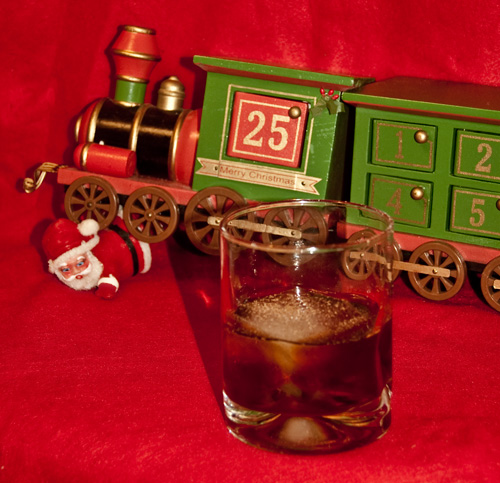
The first thought that came to my twisted mind was of a Christmas tree burning down, and I knew I had a bottle of Douglas fir eau de vie that would offer a nice base for burning, perhaps through a smoky Scotch or Mezcal. Unfortunately (or fortunately?) I couldn’t quite get the taste I wanted. The grassy liquor didn’t really pair well to me with some of the stronger, smokier spirits. In the end, I abandoned that approach and thought instead of burning down the whole house instead of just the tree.

And with that, I present the Gingerbread Housefire (Burning Down the Gingerbread House was a close second for the title, but judged too wordy).

Gingerbread Housefire

  • 1.5 oz. Scotch (peaty, like Ardbeg or Laphroaig)
  • 0.5 oz. Cruzon Black Strap Rum
  • 0.5 oz. Ginger Liqueur (Domaine De Canton)
  • 1 barspoon cinnamon syrup
  • 2 dashes coffee bitters

Stir and strain into old fashioned over rocks.
Dust with fresh nutmeg. (Can grate fresh cinnamon as well.)

There’s a smoky base of peaty Scotch with the molasses from the Black Strap, some sweetness and bite from the ginger and cinnamon, with just a little of the coffee bitters for balance. The nutmeg serves as a nice dusting of ashes on top. A festive holiday gone very wrong.

As I was playing with the first drink I hit upon a second that I wanted to try, using a fig, vanilla and black pepper syrup that I had on hand. The fig, of course, is what led me down this road.

Take Your Damn Figgy Pudding Cocktail

Take Your Damn Figgy Pudding

  • 1.0 oz. Snap Liquor
  • 0.5 oz. Cruzon Black Strap Rum
  • 0.5 oz. Fig Vanilla Black Pepper syrup (Jo Snow)
  • 0.5 oz. heavy cream
  • 0.25 oz. Allspice Dram (St. Elizabeth)
  • 1 egg white

Shake and strain into coupe.
Dust with nutmeg.

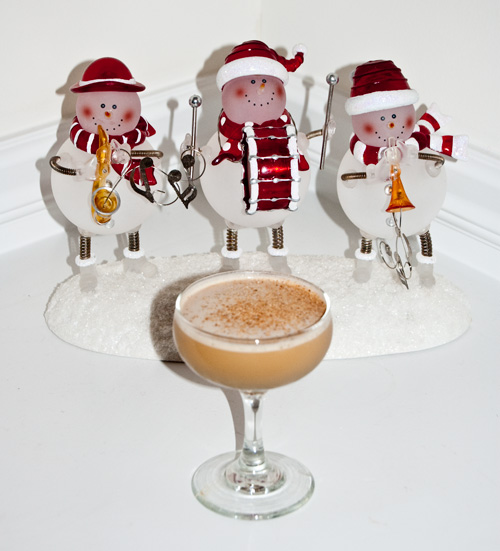
Here is my eggnog contender, thrown in the face of carolers who demand you feed them with some outdated dessert that no one prepares anymore. The Snap Liquor, which I tried unsuccessfully to use with Scotch in the Gingerbread Housefire, has a bit of molasses, cinnamon, clove and nutmeg. More molasses comes from the Black Strap. Some more spice and seasonal flavors make their way into the drink from the allspice dram, and then the egg and cream create that familiar thick nog texture (and are components in actual figgy pudding, that is if you put whipped cream on top).

A little sweet for my tastes, but then I’m not the one caroling door to door in a treacly manner.

Ho ho ho.

Burnt Sienna

Burnt Sienna cocktail

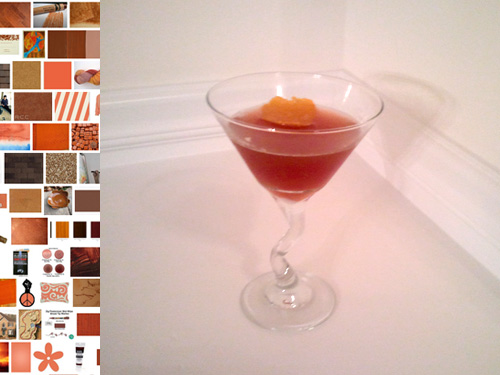
The third color in the Cocktails in the Park with George series is for the pigment burnt sienna, well known from my childhood box of Crayola crayons and with a hex value of #E97451. I immediately gravitated to a Blood and Sand variation, possibly because of the colors that those elements evoke in my mind (not that I remember bleeding too often into a sandbox as a child).

Burnt Sienna

  • 1.5 oz. Laird’s Bonded Applejack
  • 1.0 oz. orange juice
  • 0.5 oz. Cherry Heering
  • 0.5 oz. Dolin Blanc vermouth
  • 2 dashes The Bitter Truth Creole bitters

Shake with ice and strain into cocktail glass.
Garnish with burnt orange peel.

Laird’s produces a more commonly found applejack that isn’t bottled in bond (100 proof), but it does sport a different taste, if just for the fact the alcoholic content is less than the bonded version. I only recently found a location that stocked the bonded version after I was informed by a bartender that due to the convoluted Massachusetts liquor laws the bonded version could only be sold to an establishment that also sold cigarettes. Yeah, that makes sense. (By the way, applejack and apple brandy are not the same thing, as this article helpfully explains.)

Now the Blood and Sand is Scotch, orange juice, sweet vermouth and Cherry Heering, so you can see I didn’t stray far. My main alterations were raising the proportion of applejack (substituted for the Scotch) as its taste isn’t as dominating to me as Scotch, plus I liked more of an apple contribution. I then lessened the participation of the Cherry Heering (which I find can be very overpowering) and the vermouth. The Dolin Blanc is a less sweet vermouth that lies somewhere between traditional sweet and dry vermouths. I do like to use this to lighten a particularly strong tasting drink that needs to retain some sweetness.

The bitters here are similar to Peychaud’s in color and taste, though I find they add a little more of a spicy bite, which worked nicely with a drink with so many sweet components. And they helped with the color.

Oh, a final note on the burnt orange peel: The Blood and Sand can get the orange peel garnish. I thought for a Burnt Sienna it was wrong to not add its flaming cousin, and it’s really not hard to do. Here’s a handy video that explains how.

Organic Red Lake

Organic Red Lake cocktail

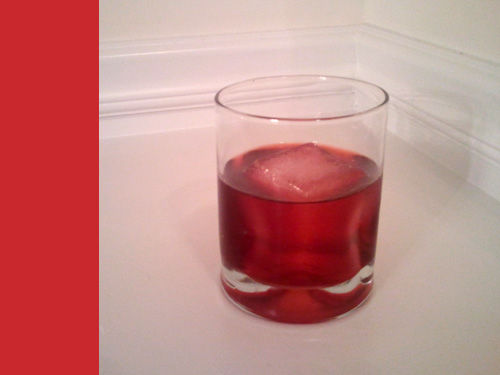
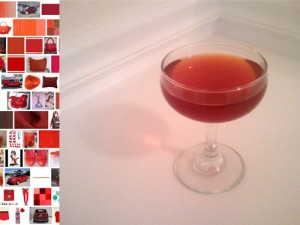
The second pigment in my Sunday in the Park with George set was organic red lake. It wasn’t as easy to find examples of as vermilion, as you can tell by the image above which does not contain the result of a Google search but instead shows the color swatch from a paint brand. The color is a deep red with some yellow undertones. Looking back, I think I strayed more in the direction of blue, but as the other two red drinks were on the yellow side I don’t regret that mistake since it produced a tasty drink.

Organic Red Lake

  • 2.0 oz. Aged Rum
  • 1.0 oz. Crism Organic Hibiscus Liqueur
  • 0.25 oz. Maurin Quina
  • 4 dashes Peychaud’s bitters
  • 4 dashes cranberry bitters

Stir and strain into old fashioned over ice glass.
Twist lemon peel and discard.

One thing I wanted to do with all of the cocktails in the series was to use a different base spirit for each, and, for the most part, different bitters and mixers as well (juices I wasn’t as worried about). And yet, here in the second drink I resorted to Peychaud’s to help the coloring. I tried to be better from here on out.

I love aged rum as a base, and here I used Mount Gay Extra Old, though Bacardi 8 or Ron Zacapa would work equally as well, I think. The Crism added a floral sweetness, and is not a mixer I used a lot, as I discovered when I emptied my bottle in preparing this drink for my cast and couldn’t find a replacement anywhere. It seems it has been so long since I purchased the bottle that it is no longer made in the form I had it before. It was either bought or rebranded, but I believe it is now found through this company and now is simply called Fruitlab Hibiscus Liqueur. As I have not found a bottle, though, I cannot say if it tastes the same or (less importantly) provides the same color. You could substitute another sweet floral liqueur, like St. Germain perhaps, though of course that would produce a different drink.

The Maurin Quina is a great ingredient that I have been playing with a lot in the last several months. It is a quinine and cherry based aperitif that adds a wonderful tart/sweet/bitter -ness to a drink. Finally, the added bitters contributed greatly to the color, but also toned down the sweetness, though the Fee Brothers cranberry definitely have a sweetness to them in addition to their tartness and bitterness.

Vermilion

vermilion cocktailvermilion cocktail

The first pigment used by Seurat in A Sunday Afternoon on the Island of La Grande Jatte that I created a drink from was vermilion, a mostly red (not mostly-dead) color with slightly more green than blue (hex value #E34234 for the web developers playing at home).

Vermilion

  • 2.0 oz. Silver Whiskey
  • 0.5 oz. Chambord
  • 0.5 oz. Ramazotti Amaro
  • 0.25 oz. lime juice
  • 3 dashes Peychaud’s bitters

Shake and strain into a coupe.

As this was my first paint color drink, and I was oh so young and naive, I started with a colorless base spirit in the Silver Whiskey (High West Western Oat), which is unaged so doesn’t take on the coloring you get from the barrel aging process. This was a mistake in retrospect as I got to later colors that couldn’t use a brown spirit base, which this could have used, but you must forgive my youthful transgressions.

I added the Chambord for the sweetness and tried to balance this with Ramazotti for something bitter (and the right color) and the lime juice for some acid — it also helped to add a little green to the color, which was becoming too purple. The Peychaud’s, I am forced to admit, was a cheat to get the color just where I needed it (I used it again in the next drink for the same reason; it feels good to come clean).

Nothing too off the wall in this one, and it was darn tasty. And the color looked like a drink I’d want to consume (have I mentioned the blue drinks yet?)!

Cocktails in the Park with George

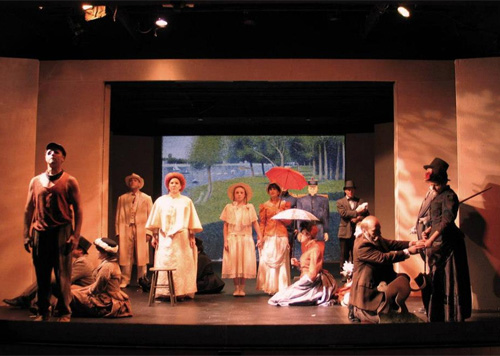
Scene from Sunday in the Park with George at Vokes Theater, Wayland, MA
The last production I was fortunate to be a part of was Sunday in the Park with George at Vokes Theater in Wayland, MA (that’s me with the beard in the lower right setting up the monkey). This James Lapine and Stephen Sondheim Pulitzer Prize-winning musical tells a mostly fictional account of the nineteenth century artist Georges Seurat’s time spent sketching for and painting his famous A Sunday Afternoon on the Island of Grande Jatte, his failure to connect with those around him during this process (and during his short life), and his (totally fictional) great-grandson’s resolution of art and relationships 100 years later. In a nutshell. Oh, and I got to sing as a couple of dogs.

When I first began to consider drinks I might make inspired by the show, I looked at the mantra Georges repeated throughout the show, his list of attributes that contributed to the creation of his art: order, composition, balance, light, harmony (among others). However, these proved too abstract for me (maybe a pousse cafe for order? an equal parts drink for balance?) so instead I turned to the eleven colors Seurat used in his first phase of the painting (there were three phases, I guess, with the second one in which he added the monkey and the third when he painted a pointilistic border around the painting; both phases added to the number of colors used, but I only have so much liquor).

There is a line in the show where Georges states, “Eleven colors, no black. Not mixed on the palette, but mixed by the eye.” Lovely. And false, really. Seurat used these colors, yes, but he did mix them freely on the palette before applying them the canvas. Ah well, artistic license.

But I did have eleven distinct colors (or so I thought until I had to make minor blue and yellow variations, but we’ll get to that…). My decision then was to create a set of drinks based on colors, where the spirits and mixers involved did not contribute to any story behind the drink other than the pigment they provided. I thought it was an interesting challenge with a lot of potential for flavor combinations unencumbered by theme (again, until I got to those damn blue drinks…).

For reference, the colors Seurat used were:

  • Vermilion
  • Organic Red Lake
  • Burnt Sienna
  • Iron Oxide Yellow
  • Cadmium Yellow
  • Chrome Yellow
  • Viridian
  • Emerald Green
  • Ultramarine Blue
  • Cobalt Blue
  • Lead White

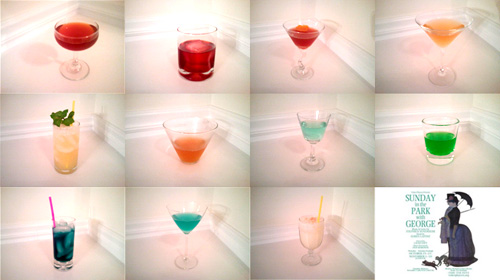
As I am writing this post after the completion of the full set, I can tantalize you with the image of all together before I break each one down individually.

Sunday in the Park with George Cocktails

As Georges is written to say, “Can’t you see the shimmering!”

The Alchemist

Ralph Steadman's The Alchemist over my home bar.

Above my home bar I have a framed print of The Alchemist by Ralph Steadman (you might have seen his work illustrating Hunter S. Thompson). This is a bit of a happy accident as I bought the print before I was into cocktails and had it hanging before I had the bar set up. I have a bar set up not because I set out to do so, but because my small collection of bottles in the pantry multiplied and wore out their welcome from my wife, who doesn’t drink and therefore does not contribute to finishing off bottles. I began buying bottles of spirits and mixers in the first place to replace the wine I was consuming, since I thought at the time (hilariously so, now in retrospect) that it would be cheaper.

But back to the alchemist. I love his tinkering. I love his collection of assorted ingredients and tools he has lining the walls. I love his anticipation of what effect dropping the mouse in might have on his potion (I have never used mice. Probably never will.). I love that this sits over my bar. It belongs there.

Does this site belong, though? I do not intend to blog. I do not intend to write any recipe book reviews or discuss bars I have visited or drinks I have consumed, as excellent as they may be. This might be the most personal post I ever write, as I do not intend this as any sort of life journal. I have tried blogs before and have found that is not me.

What I have found in the last year, though, is that I am making up my own concoctions more and more and desired any easy way to record these and share them with those who might be interested. Generally, my drinks have been thematically tied to a show I am performing in (and promoting through alcoholic beverage). Sometimes I have just picked up an interesting ingredient and am trying to make it work. For all of it, though, I am doing it just for fun.

I am not a bartender, nor do I have such aspirations. I am not a mixologist, and shrink a bit at that term. I am not an expert by any means, and still learn so much as I go to different bars and read different manuals or attend events. I know just enough to be dangerous, as they say. I am an enthusiast (a dangerous one, I guess), and I like mixed drinks.

So, I will dutifully record what I do, mostly cocktails, but sometimes some other creative production like posters I create for shows. If you are interested, check it out from time to time, and let me know what you think. After all, where else might you find a drink inspired by a musicalized American assassin, or based on a paint pigment used in a nineteenth century neoimpressionistic painting?

And who knows, I might get around to using a mouse.