John Cleese

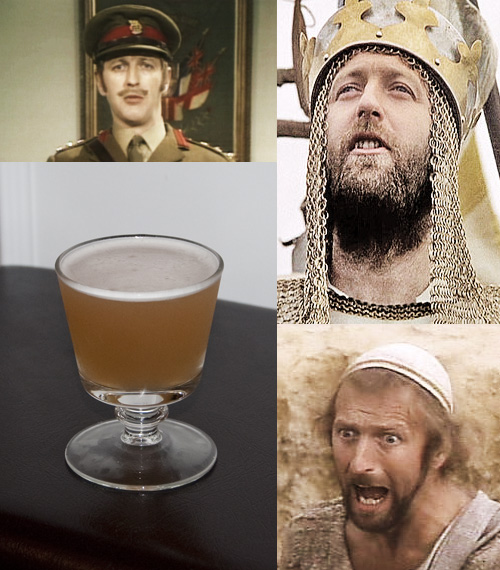
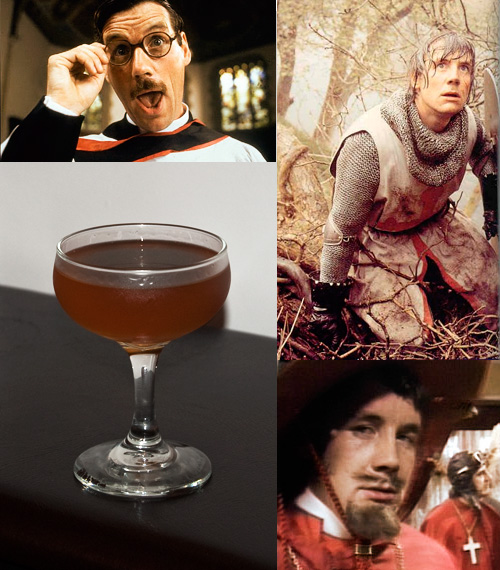
Yesterday was John Cleese’s birthday (along with my daughter’s, as it happens), and so a perfect time to bring out his Spamalot cocktail.
johnCleese
John Cleese

  • 1.5 oz. Cognac
  • 1.0 oz. dry vermouth (Martini)
  • 0.5 oz. Jagermeister
  • 0.5 oz. honey syrup*

Stir and strain into coupe rinsed with peaty Scotch (Laphroaig 10).

* For honey syrup, heat equal parts honey and water, reducing slightly.

For Mr. Cleese, I went with an international theme. The Cognac is for the French Taunter in Holy Grail, but could equally be for others, like the waiter in Meaning of Life. The vermouth, much needed in this drink to open it up a bit from the other, sweeter elements, must be an Italian dry like Martini. I put this in for A Fish Called Wanda, as his character of Archie is fluent in Italian and uses this (along with Russian) in a hilarious scene with Jamie Lee Curtis. The Jagermeister is German, but DON’T MENTION THE WAR! It adds a sweetness and bit of an anise hint to the drink. More sweetness comes from the honey syrup, a nod to Eric the Half-a-bee.

If I could have put a silly walk into the drink I would have done that as well.

Terry Gilliam

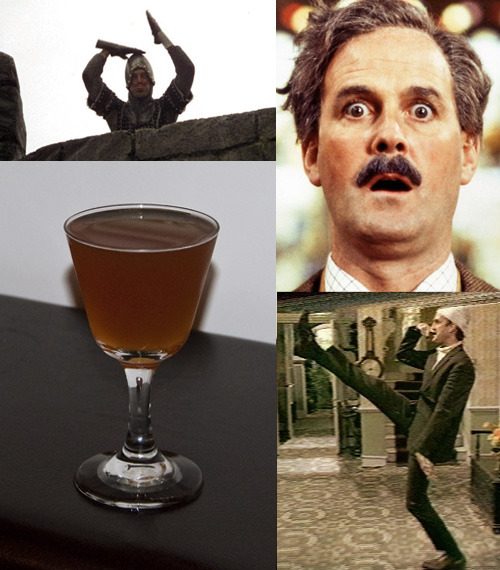
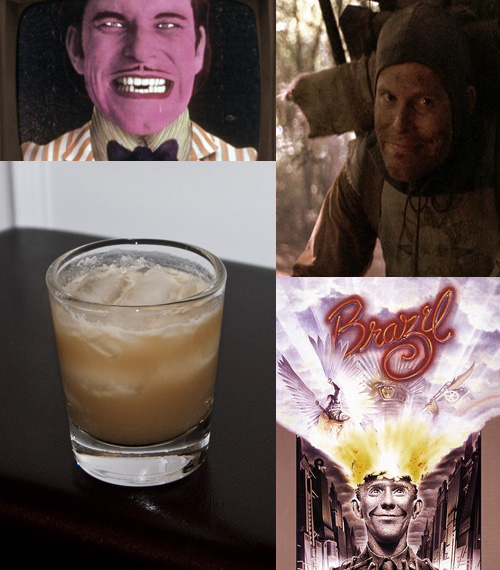
For cocktail #2 from the Spamalot collection, I turned to the Python who appeared less in front of the camera yet whose illustration and animation defined a good part of the feel of Flying Circus, Terry Gilliam.

terryGilliam

Terry Gilliam

  • 2.0 oz. Cachaça
  • 0.5 oz. lime juice
  • 0.5 oz. Coke syrup*
  • 0.25 oz. cream of coconut

Shake with ice and strain into ice filled old fashioned.

* For Coke syrup, reduce Coca-cola over heat by half.

As Terry Gilliam has since Python days moved on to establish himself as a unique and talented director, I wanted to start with a base spirit that payed homage to that, and to his masterpiece, in my opinion, Brazil. Enter the sugarcane-based Cachaça, national spirit of Brazil. To this I added lime juice, following a similar path to a Caipirinha, but then added reduced Coke syrup for sweetness as opposed to sugar (and moving in the direction of a Cuba Libre).

There is some thematic thread here as well. I wanted to take a distinctly American product like Coke, since Mr. Gilliam has that origin, and then throw in the lime for his later adoption of Great Britain as home (c’mon, you didn’t think I could get through six Monty Python cocktails without a single Limey reference, did you?).

In addition, I wanted to represent his illustration and animation, a tough task for a drink. Then it came to me to flatten the carbonated soda, a nod to his 2D animation style.

The cream of coconut, of course, is all Holy Grail. Imported by swallows, I believe.

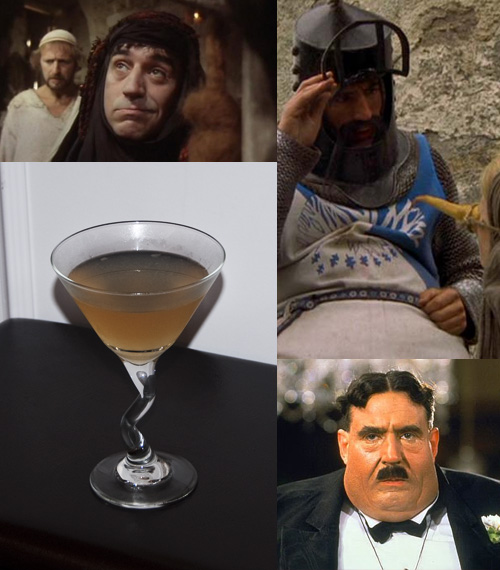
Michael Palin

For the Spamalot cocktails, I thought I would focus on the Pythons themselves, not on the show necessarily, drawing from their work both within and outside the troupe. That would give me six cocktails and wealth of sources to draw from. And I started with the “It’s…” Man himself.

michaelPalin

Michael Palin

  • 1.5 oz. Irish whiskey
  • 1.5 oz. Amontillado sherry
  • 0.5 oz. Sugar Maple liqueur
  • pinch of Himalayan salt

I started with an Irish whiskey base (Jameson’s 12) as Mr. Palin has some Irish roots which he explored in some of his travel series. I also wanted something for his Catholic father from Meaning of Life, and thought an Irish whiskey could be fitting. To this I added some Spanish sherry, which might be unexpected …but “No one expects the Spanish inquisition!” For sweetness, in came the Sugar Maple liqueur, I am sure a favorite of lumberjacks everywhere, and I finished up with pink Himalayan salt, an additional nod to Mr. Palin’s travelogues, one of which was a trip through the Himalayas.

Now must be off. My brain hurts!

Monty Python’s Spamalot

Earlier this year I got to act through some of my favorite movie comedy scenes, reset on the musical stage, in Mel Brooks’ Young Frankenstein. “Put the candle back!” It was a geek’s dream.

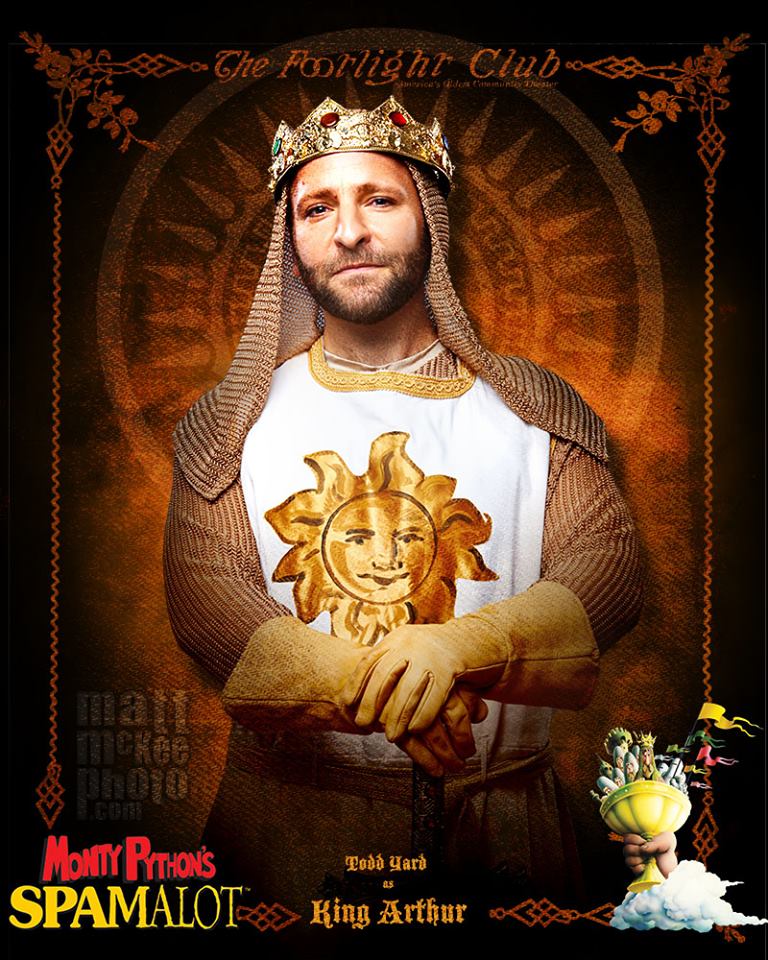
What experience could follow that up, and maybe even top it? How about a turn as King Arthur in Monty Python’s Spamalot, performing some of the funniest sketch comedy (masquerading as a plot) that has ever been written?

Well, OK.

toddyard_kingarthur

This went from geek dream to full on geekgasm (can I say it “took it to 11,” in the hopes a This is Spinal Tap musical might appear in the near future and complete a personal trilogy?).

And lo, there would be drinks. And there was much rejoicing.

Great Scot

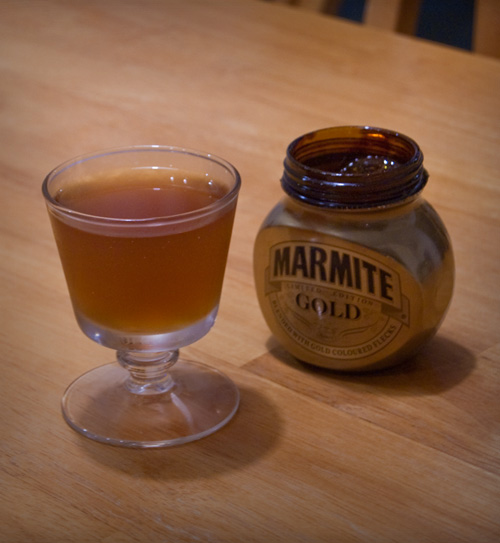
I was issued a challenge and gifted an ingredient: Marmite in a cocktail. For those of you not familiar, Marmite is a yeast extract popular in England, often spread thinly on toast. It is strong. Pungent. An acquired taste at best. A cocktail is probably not your first thought on tasting it (unless that thought is to mask the taste).

Not one to back down, I took the Marmite (Marmite Gold as it turned out, a special edition with gold leaf) and after many unsuccessful iterations present Great Scot.

greatScot

Great Scot

  • 2.0 oz. Old Tom Gin
  • 1.0 oz. Yellow Chartreuse
  • 0.25-0.5 oz. Marmite simple syrup*

Stir with ice and strain into coupe.

* For the simple syrup, reduce 2 cups of water with 2 tablespoons brown sugar and 2 teaspoons of Marmite.

The idea here was not to mask the Marmite flavor, but really to highlight it. If you don’t like Marmite, chances are you will not like this drink. It is certainly more savory than sweet, as I think is appropriate.

Initially, I started down the road with Mezcal, thinking it might pair nicely. It really didn’t. I also had trouble with the Marmite, as it hardened when mixed with liquid into a sort of hard Marmite candy. To get around this I reduced it in some boiling water along with some brown sugar. My house stunk.

After a couple attempts with Mezcal, I tried Old Tom Gin, a slightly sweetened gin, and that worked much better. The Yellow Chartreuse’s herbal qualities I thought played nicely with the Marmite, certainly keeping it featured but toning it slightly down.

The name is a nod to the issuer of the challenge, and hopefully (perhaps only) drinker of the cocktail. A fun challenge. An odd drink.

Hedda Gabler Poster

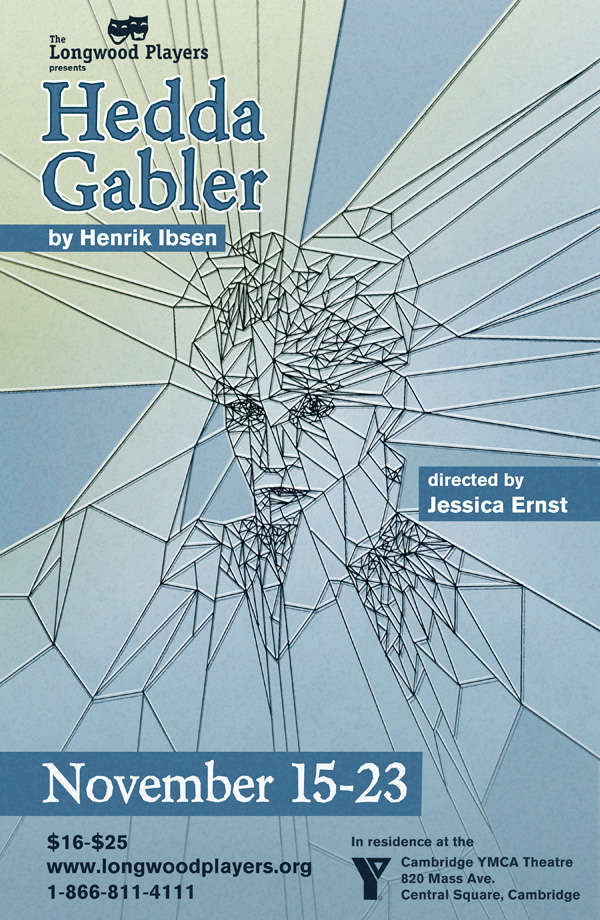
Quick break from cocktails to show a poster design I put together for a local company, The Longwood Players. This was a bit of an emergency project as their original designer fell off the grid after deadlines were passed (ironically, they had moved to this designer without my knowledge, perhaps after the unfortunate situation surrounding my Chess poster). I had to put this together over a weekend to help them out. The result was the following:

hedda_poster

I wanted to focus on Hedda herself, and her internal conflict, her boredom and loneliness and mania. I saw some wonderful pictures online featuring images created by a cracked glass algorithm that I wanted to try and replicate, with the idea being the fragmented state of Hedda’s mind and existence. In the end, the image became more stained glass with a bunch of tessellations than cracked glass, and I didn’t have the time to rework it, nor write my own algorithm (this was all manual) to create the randomness of the image. I also did not feel that the stained glass was inappropriate, so I stuck with it as the image came together.

My wife, Lydian, served as the model, wearing pajamas with her hair tied back at the end of the day. Probably the easiest two minute modeling gig she’s ever had, but her pose makes the poster.

The Unparalleled Philistine

unparalleledPhilistine

For my single Roar of the Greasepaint cocktail, I wanted something elevated and something common. I thought I might go with some wine in the mix — there is certainly enough consumed by the characters in the show — but also thought gin made sense for the more common element and couldn’t see the wine working out. In the end, I decided on a half and half recipe representing the two main characters of Sir and Cocky.

Then, of course, came finding the name. There are a number of delightful phrases in the book that could probably fill a bar menu: All Due Respect, Towering Eyeful, Ars Ex Libris, Purple Fit, St. Clarence the Stutterer (or St. Vitus the Uninhibited), Your Move, I could go on and on. The color of the drink recommends The Green-eyed Monster, also spoken in the show, but as that is a reference from Othello it didn’t seem right.

In the end I kept returning to the Unparalleled Philistine, an insult from Sir to Cocky that Cocky misinterprets as a compliment, and a nice phrase of duality to match the ingredients of the drink.

Unparalleled Philistine

  • 1.5 oz. G’vine Gin (or use a London Dry)
  • 1.5 oz. Green Chartreuse (use VEP if you got it)
  • 2 dashes lactart

Stir with lots of ice (needs a good dilution here) and strain into coupe.

Here is common gin (Cocky) mixed with a higher end herbal liqueur (Sir) with a few dashes of lactart (just gives a tartness to a drink — like citric acid from juice without the juice). A London Dry like Beefeater or Gordon’s would probably be more appropriate, but the G’vine here is a nod to the wine in the show (G’vine comes from grapes) and I felt played well with the Chartreuse. The lactart is actually a little bit of acid as a nod to the character of The Kid in the show, Sir’s apprentice and taunter of Cocky.

Cocky does a lot of guzzling in the show. This is definitely one for sipping. With all due respect.

The Roar of the Greasepaint – The Smell of the Crowd

My next production, which opens this weekend, is a bit of a labor of love a long time coming. I did this show 22 years ago and always wanted a chance to do it again. The problem is that no one ever does this show. That’s a shame, because there’s there some wonderful material here. Perfect? By no means, but neither is a good chunk of theater that is done constantly, and no others have the gorgeous songs “Who Can I Turn To?” and “Feeling Good” among others.

The story itself is allegory for the British class system, and this is one reason the show is avoided, certainly in the US. People think its politics are outdated. The ideas are absolutely simplified, but the story of Haves and Have-nots, where the ruling class defines rules in order to keep the lower classes in their place, is certainly one I feel is relevant to our current political climate in this country.

In the show, Sir is the Have playing against Cocky the Have-not on a life-size gameboard. The setting is not clearly defined (it’s a barren landscape in the script, and Leslie Bricusse once said the show was supposed to take place in the post-apocalyptic world everyone suspected was coming at the time the show was written in the 60’s). The songs are all fairly liftable, meaning that for the most part they aren’t woven seamlessly into the story as musicals now tend to do it (or try to) and the scenes seem like British music hall comedy routines. It’s a weird and lovely (and very darkly comic) show.

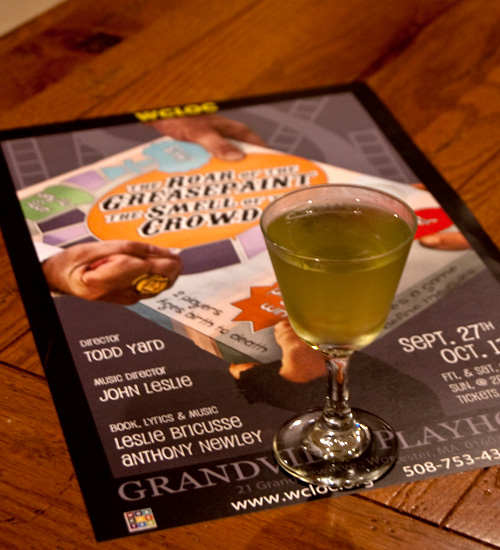
So how would you portray this on a poster? That was my challenge here. The original production simply had a silhouette of Cocky and Sir arguing over a bag. With all due respect to the original designer, I don’t feel this says much about what the audience has in store. The fact that ANTHONY NEWLEY and CYRIL RITCHARD appear over the title probably made the graphic not nearly as important.

For my production though, which I was directing and choreographing as well as performing in (not my original intention — I really wanted to do the show, and no director came forward to apply), I wanted a poster that showed the struggle, but also pulled in the “game” aspect. This was important since my setting was actually to be a toy shop in ruins and I felt there should be some toy aspect on the poster. In addition I wanted to show the struggle between the two characters and, if possible, convey a feeling of circa 1960, but in ruin.

The end result was this:

greasepaint_poster_3

The photos are all of my hands, actually, and the gamebox is a Dora the Explorer Chutes and Ladders game that I then modified with the new artwork digitally. I tried to use colors that I saw on old games from the 60’s (Life, certainly) along with an appropriate font, and started the game on the box with a mushroom cloud. The taglines I felt added just enough insight into what goes on in the show (playing for bread or love, from birth to death), and the chutes and ladders in the background add some additional texture.

Probably one of my favorite touches, not apparent in this low-res version, is the ring on the finger made from a coin bearing the likeness of Queen Victoria. The raised edges on the ring have dried blood. Like I said, the show is darkly comic, and I felt the violence should be at least subtly represented on the poster.

That’s the poster, now how about a drink? As the cast is mostly underage kids, I wasn’t really inspired to create a whole suite of cocktails (I mean, there’s not going to be a cast party to try them out), but I had to do one, didn’t I? Coming next…

The Flying Hat

flyingHat

OK, I thought I was done with the Light in the Piazza cocktails, but then I saw a limoncello with the label Fabrizia on it. Fabrizio is the name of the young lover in the show, so I couldn’t pass it up. Thus:

The Flying Hat

  • 1.5 oz. Fabrizia limoncello
  • 0.75 oz. lemon juice
  • 0.5 oz. Herbe di Amalfi Basil liqueur
  • 1 barspoon Fernet Branca
  • 2 dashes grapefruit bitters

Stir with ice and straing into a champagne flute.
Top with 3.0 oz. American sparkling wine.
Garnish with a half grape on a toothpick.

Once more, stuck to Italian mixers mostly. Basil, lemon, a nice tart sweetness. The Fernet cuts into that just enough. The sparkling wine is American for the character of Clara, but you can top with whatever you’d like, obviously.

The grape is the hat, if not so obviously.

Il Signore

ilSignore

I had a request from a friend and cast member of the Light in the Piazza to create a drink specifically for him, with the only request being for it to be sweet. As this individual was playing Signor Naccarelli, I produced something I felt appropriate for such a gentleman.

Il Signore

  • 1.5 oz. Carpano Antica sweet vermouth
  • 1.0 oz. Cognac
  • 0.5 oz. Amaretto
  • 0.5 oz. Cynar

Stir with ice and strain into a coupe.
Garnish with a pinch of salt.

For the most part I stuck with Italy, with the base being a rich Italian vermouth. To this I added Cognac (just over the border, right?), some Amaretto for more sweetness and nuttiness, and the Cynar for some needed bitterness. I love myself some saltiness with sweet, so the pinch of salt enhanced the final composition for me.

I don’t go for overly sweet drinks myself usually, but found this one offered a richness that still appealed to me. And I’d take this dessert any day over a bowl of ice cream.