Chess Poster

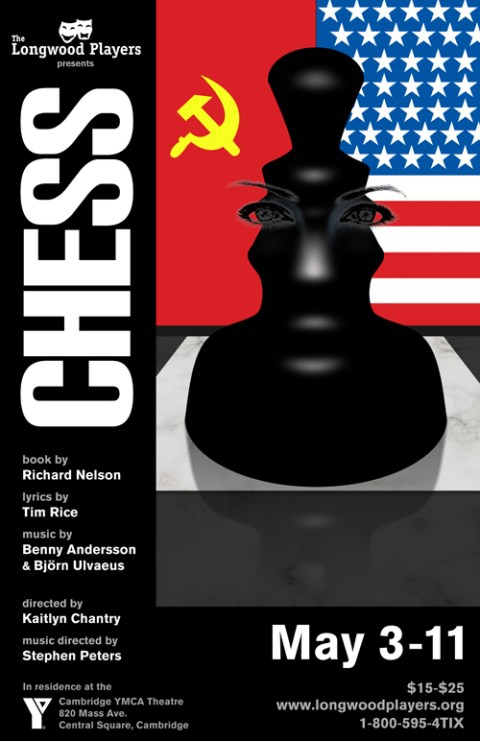
As a temporary break from cocktails, I thought I might post another of my recent creative endeavors, the creation of a poster for a local production of the musical Chess (for those not into the whole scene, it was the one written by the guys from Abba back in the 80’s that included the radio hit “One Night in Bangkok”). And it serves as a lesson to me in how to handle projects like this in the future, as you will see.

So, to begin, the musical has a backdrop of international chess competitions, and, taking place during the Cold War, it focuses on a rivalry between the US and the USSR. There’s espionage and a love story between a Russian defector and an American woman who serves as second to the American competitor. It’s all a bit convoluted, and the book is a bit of a mess, but the music is pretty catchy even if the lyrics are somewhat clunky and heavy-handed to my ear.

I knew that I wanted some central chess image, and you’ve got either a checkerboard or a chess pieces, really. The original concept used a checkerboard falling apart, which I quite like, and the Broadway had two people running in front of flags without any hint of chess, which I don’t like at all. I thought I might create a chess piece that would create an optical illusion in the empty space of the two competitors facing off. Once I had done this, I was surprised to find that the highlights on the chess piece implied a second illusion of a face. I went further with this and created a woman’s face that was between two competing men, which I thought captured the triangle in the musical.

poster

After getting approval to move forward with this concept, I added a chess board below the piece and wanted to texture this with marble, which mimicked a chess board I had when growing up. During that process, I threw the marble behind the piece as well since the empty space was bothering me a bit. At that point I discovered that I could place the texture in such a way as to imply faces for the silhouetted figures, which I thought was a nice, subtle touch. After that it was just about getting all the words on to the poster, the greatest challenge for me, generally.

chess_poster_marble

To quote Fantine, “And then it all went wrong.” Unfortunately, although I really liked it, this wasn’t the direction the creative team wanted to go. To them, there was no relationship triangle in the show and their production would be focused on the espionage and the US vs. USSR, something I hadn’t been told at the beginning of the process. They were quite right that this poster didn’t promote that idea. I was very proud of the result, but it wasn’t right. They also didn’t like the marble and instead wanted something that showed the political angle. And then I made a mistake.

To show that filling the silhouetted space with something like flags would not only ruin the illusion, but also be a little too much hitting the nail on the head with a sledgehammer in a poster with too many ideas, I threw the following together. I thought it would be quickly dismissed and that I could move forward with the poster I liked.

chess_poster_flags

You can probably see where this is going.

They loved it. I offered to try something else to get the political angle in without destroying the initial concept. I didn’t love this either, but felt it was a better option at least.

chess_poster_reflection

Nope, no good. They felt this was too many ideas, which I completely agreed with (I think I might have said it first), that somehow the flags in the background avoided, which I didn’t agree with. So in the end, since it is their production and not mine, and it needs to express what they want it to express, I cleaned up the flags in the background and gave them this.

chess_poster_final

I do believe it has too many ideas crammed into it and the illusions of both the silhouettes and the woman’s face are a bit lost (and, when not lost, looks like they have hats, as my wife commented), and if I could approach it from scratch I would do it completely differently, but with deadlines looming and my time extremely limited (I also volunteer for this — it is not a paid gig) we had to move forward with this, a piece I am wholly unsatisfied with, which is frustrating since I was so happy with the original product.

Lessons to me are never to proceed with anything unless I get very clear instructions on what is desired from all parties involved, even if deadlines are approaching. And, more importantly, never submit something that I know I do not like. This was my fault and completely backfired in this case. I knew I hated the flags. I assumed everyone would hate the flags. I never should have mocked it up.

Lesson learned. Now it’s time to make a drink.

Emerald Green

emeraldGreen

Now we start getting into the odder colors in our Cocktails in the Park with George palette. We’ve left the cozy confines of the reds, oranges and yellows and now veer left at the Land of Oz to emerald green (hex value #50C878).

Emerald Green

  • 1.0 oz. Akvavit (Aalborg)
  • 1.0 oz. Midori
  • 0.5 oz. Thatcher’s Cucumber liqueur
  • 0.25 oz. lime juice
  • 1 barspoon green Creme de Menthe

Shake with ice and strain into cocktail glass.

I just had to break out the Midori and the Creme de Menthe for this one, these being two dusty bottles I probably purchased in my first round of mixer buying years ago since a) they were cheap and b) with my limited knowledge of cocktails at the time these were two I had actually heard of before. However, after mixing a Melonball and a Grasshopper (I know..) there was not much else I could find for these and they got relegated to a forgotten corner of my bar. Until now.

Since I was starting with melon as a base, to which I knew I was going to add a bit of mint, I needed a flavor to complement this bit of a farmer’s market and I thought Akvavit would work nicely with its caraway and anise undertones. I chose the clear, unaged Aalborg from Denmark to help keep the green cast of the finished cocktail. For an additional bit of sweetness I added the cucumber liqueur, though its taste is so subtle against the bolder flavors that it comes off as a lighter simple syrup. Then, for a bit of brightness and tartness I added the lime juice, which didn’t detract from the color (let’s face it, the Midori is almost radioactive in appearance and obliterates most of the other colors anyway).

Even just a little creme de menthe can take over a drink, so a barspoon is all that’s needed here, which still makes its presence known in the final drink. At the time I made the drink I used a cheap mixer I will probably never empty, but since then I have spotted the new offering from Tempus Fugit. As their new creme de cacao is so phenomenal, I am curious to know whether their creme de menthe is as eye opening. Who knows, perhaps a bottle of that could come out from the forgotten corners of the bar and play a bigger part in future cocktails?

The Kilted Heir

Mixology Monday

This month’s Mixology Monday theme, as presented by Chemistry of the Cocktail, is Fortified Wines, and so I took a break from the Island of La Gande Jatte to throw my own libation into the mix. From the announcement:

Fortified wines began, in large part, as a way to deal with the difficulties of shipping wine long distances in the holds of sailing ships. Without the rigorous sterilization that is possible today, wines would often spoil en route. However, increasing the alcohol concentration to around 20% ABV was enough to keep them from going off. Coincidentally, this also made it possible to age those wines for very long periods, increasing their richness and depth.

Now, I use fortified wines all the time in the form of the many variations of vermouth, but for this challenge I wanted to go with an ingredient that I didn’t normally use (and vermouth has had its own Mixology Monday in the past). It so happened that I had a bottle of Madeira that I was saving for cocktail exploration at some point so this was a great opportunity to open it up. Generally I don’t use things like Port, Madeira or Sherry just because they, like vermouths and other fortified wines, require you use them within a short amount of time before they turn. Yes, they do keep a while — that was the whole point — but they don’t keep for months and months (please don’t leave vermouth out in your bar for a year; throw it out, I beg you). I only have so much room in my refrigerator I can use before my wife files divorce papers, so I have gone with the more easily mixed vermouths than with something like Madeira.

But here I knew I was going to be trying a lot of experimenting and would probably quickly go through the bottle. This was certainly the case as in the end I went through so many variants before arriving at my submission for the month, The Kilted Heir:

kiltedHeir

The Kilted Heir

  • 1.5 oz. Madeira
  • 1.0 oz. blended Scotch
  • 0.5 oz. Amaro Nonino
  • 2 dashes Angostura bitters

Stir with ice and strain into coupe.
Garnish with an orange twist and 3 drops of salt water.

Madeira offers a spicy nuttiness that I thought paired well with a blended Scotch (I used Famous Grouse) and the sweet nuttiness of Amaro Nonino. There’s a spiciness to Angostura as well, so this added to the depth and the bitter note pulled everything together for me. The orange garnish added nicely to the nose of the cocktail, and the salt water was a last minute addition I made after the first couple of sips. I felt it brought out the spices all the more.

The name derives first, probably obviously, from the Scotch component. The “Heir” is a hat tip to Henry the Navigator, the man who discovered the Madeira Islands, who was Infante (great name for a cocktail, but, alas, already taken), or heir to the king. Or at least Wikipedia tells me so.

I did have quite a few other attempts at pulling Maderia into a drink, most admittedly not successful. I found that either the Madeira didn’t play well with other flavors, or else I masked it so much that it defeated the purpose. I felt The Kilted Heir did a fine job of highlighting the Madeira while still creating a unified drink. Some others that I did enjoy I list here for sake of recordkeeping.

Fronkensteen

  • 1.0 oz. Madeira
  • 1.0 oz. sweet vermouth (Torino Vermouth de Torino)
  • 1.0 oz. Old Monk rum
  • 1.0 oz. Cynar

Stir with ice and strain into coupe.
Garnish with an orange twist.

Basically a Negroni using Old Monk and Cynar, with Madeira added into the mix. The Old Monk, one of my favorite bases to mix with, could hold its own against the Madeira with its spiciness. It was good, but not terribly original, which is why I did not feature it. The name obviously comes from the pronunciation in the Mel Brooks movie Young Frankenstein, the musical adaptation of which I was just cast in when I made the drink. Can’t wait to get started on those themed drinks!

Forte Without the Ay

  • 1.0 oz. Cognac
  • 1.0 oz. Madeira
  • 0.5 oz. Averna
  • 2 dashes orange bitters

Stir with ice and strain into coupe.
Garnish with an orange twist.

This was a minor variation of The Kilted Heir. I wanted to try a Cognac base instead. Another drinkable concoction, but I felt the Scotch base led to a more robust drink.

The name comes from a little peeve of mine concerning the pronunciation of “forte.” It’s pedantic, so forgive me, but we all have our little quirks, don’t we? When someone says, “That’s my forte,” most often they give it two syllables as in the Italian pronunciation. However, that’s an Italian musical term that means loud. “Forte” meaning “strong point” has a different, French etymology and should be pronounced as the English “fort.”

Of course, words and the English language change all the time (as my wife and I argue “sneaked” and “snuck”), and that is as it should, so I realize it is a rather silly argument I make. In fact, the online Merriam-Webster dictionary has this to say:

In forte we have a word derived from French that in its “strong point” sense has no entirely satisfactory pronunciation. Usage writers have denigrated \ˈfȯr-ˌtā\ and \ˈfȯr-tē\ because they reflect the influence of the Italian-derived forte. Their recommended pronunciation \ˈfȯrt\, however, does not exactly reflect French either: the French would write the word le fort and would pronounce it more similar to English for. So you can take your choice, knowing that someone somewhere will dislike whichever variant you choose.

Ah, c’est la vie (pronounced “kest la vye”).

Viridian

viridian

By far the prettiest of the Cocktails in the Park with George colors/drinks to my eyes, the Viridian cocktail moves from the oranges and yellows of the previous lot into cool blues and greens (without the Windex blue we will see shortly), with a hex value of #40826D and some cool ingredients as well.

Viridian

  • 2.0 oz. Magellan gin
  • 0.5 oz. Maraschino liqueur
  • 0.25 oz. Green Chartreuse
  • 4 dashes acid phosphate
  • 4 drops salt water

Stir with ice and strain into cocktail glass.

Magellan is a French brand whose gin offering has a unique blue hue from the infusion of iris flowers. It’s subtle, but a neat effect, and serves as the perfect base for this drink. You might notice that most of the other ingredients are found (along with gin) in the immaculate Last Word cocktail. The Green Chartreuse added the necessary green tint to the drink, and from that point I didn’t see much reason to stray from the Last Word’s path, adding in the Maraschino for its sweetness.

However, lime juice from the Last Word set the color off too much from my desired end result so I turned instead to some dashes of acid phosphate, an ingredient once widely found in soda fountains that I will admit I picked up as a lark and hadn’t yet utilized much. Here, though, it added a nice bit of tartness without affecting the color in any way.

The salt water? Dunno. Felt like it needed it. Sometimes I don’t have a reason beyond that.

Chrome Yellow

chromeYellow
So at this point in my Sunday in the Park cocktails I realized I was getting to the end of my friendly oranges and yellows and I hadn’t yet used a nice aged whiskey. I had utilized a silver whiskey for my first drink, the Vermillion, but hadn’t gone with a whiskey with any color, which I knew wouldn’t be possible once I moved into blues and greens. So I turned to bourbon for the basis of my sour variation, the Chrome Yellow (let’s say something like #FCDE28 though I was going for more of something you would see on a school bus).

Chrome Yellow

  • 1.5 oz. Bourbon
  • 0.5 oz. Gran Classico
  • 0.5 oz. St. Germain
  • 0.25 oz. lemon juice

Shake with ice and strain into cocktail glass.
Twist lemon peel over glass and discard.

I am not the biggest fan of lemon juice, as I have written, but there was enough sweetness here to counter it for me. The Gran Classico added a bitterness to the sweetness from the floral St. Germain (in addition to its own sweetness and what you get from the bourbon). It also added just the right color, which, you know, is sort of the theme here.

Interestingly to me, chrome yellow was an unfortunate choice for Seurat (and others). It oxidizes and dulls over time and a fair bit of brilliance in the original La Grande Jatte painting is gone because of it, replaced by muddier browns where the more vibrant chrome yellow once was.

That’s a lesson to everyone to fresh squeeze their lemons for their drinks. I think. I’m not good at extracting morals.

Cadmium Yellow

cadmiumYellow

While I was initially posting these cocktails for Sunday in the Park with George for my friends I was called out for unintentionally teasing those unable to partake due to age or to a little human growing inside of them. My wife does not drink, so occasionally I try to put together something unique and tasty for the teetotaler. It seemed only fair to have at least one color within Seurat’s palette inspire a nonalcoholic beverage.

Cadmium Yellow

  • 3.0 oz. pineapple juice
  • 1.0 tsp cream of coconut
  • 1 barspoon ginger rice vinegar
  • 4 dashes Fee Brothers’ Celery bitters
  • 1 pinch celery salt
  • 4.0 oz. Q Ginger Ale

Shake all but ginger ale with ice and strain into highball over ice.
Top with ginger ale and garnish with a mint sprig.

Cadmium yellow is a bright and vibrant pigment (hex value of #FFF500, which is too bright to color this text with over a white background) that seemed to just call for pineapple juice as a base. Coconut of course pairs nicely with that. At that point I just started to have fun, reaching for a ginger rice vinegar I had recently picked up that I thought would cut into the sweetness of the pineapple and coconut nicely and seemed to be pushing me into a Thai direction. Thus, although I know it sounds a bit odd (and scared some of my castmates as I was mixing), I added in the celery elements. I love adding pinches of salt or saltwater to drinks, and the celery salt with the celery bitters really took the drink in an interesting direction. I topped it all off with some Q ginger ale (you can use another, but I personally favor Q) and some mint for a nice aromatic finish. Generally I don’t go for highballs or drinks topped with soda (sugary or not) as I tend to find these dominate over the liquor. However, in a drink without liquor and with such a strong, flavorful base, the ginger ale was a welcome finish.

Iron Oxide Yellow

Iron Oxide Yellow cocktail
Now for Cocktails in the Park with George (or Sunday in the Park with Cocktails — take your pick) we move out of the red/brown pigments that were on Seurat’s palette to the yellows. The first, iron oxide yellow, is a mustardy color that I couldn’t find a direct hexidecimal value for, though I did find mention of its relation to yellow or gold ochre with the value #CC7722.

More importantly, what’s in it? As odd as the name is (could you imagine ordering that in a bar?), you will find nothing particularly odd within its ingredients.

Iron Oxide Yellow

  • 1.5 oz. Reposada tequila (El Tesoro)
  • 1.0 oz. Lillet Blanc
  • 0.5 oz. Yellow Chartreuse
  • 0.25 oz. Mezcal (Del Maguey San Luis del Rio)
  • 0.25 oz. lemon juice
  • 2 dashes Xocolatl Mole bittters

Shake and strain into cocktail glass.

Reposado refers to a rested tequila as opposed to a silver or white tequila, meaning the spirit was aged from two months to a year in oak barrels, which establishes the base to the cocktail’s coloring (obviously important to this drink). The light yellow Lillet contributes a mild bit of sweet and citrus notes with a slight bitterness. The Chartreuse, yellow of course in favor over the green, offers an herbal bite, while the mezcal adds to the agave taste of the tequila with some more smoky depth. The lemon juice, which I personally use very sparingly as I always find it overwhelms my palette (and I don’t think I have a very delicate or subtle palette, but lemon juice kills what I do have) brings some tartness and the acid to the drink. The mole bitters just rounds out the whole thing for me.

Not an appealing name, I grant you, but a nice agave sipper.

Humbug Cocktails

And now for a slight break in the Sunday in the Park cocktails…

December’s Mixology Monday theme, hosted this month at Rated R Cocktails, was Humbug! Here was the directive:

Lets face it the holidays suck, yeah I said it. You put yourself in debt buying crap people will have forgotten about in a month. You drive around like a jackass to see people you don’t even like, or worse they freeload in your house. Your subjected to annoying music, and utterly fake, forced kindness and joy. Plus if you work retail your pretty much in hell, so don’t we all deserve a good stiff drink? So for this Mixology Monday unleash your inner Grinch. Mix drinks in the spirit of Anti-Christmas. They can be really bitter and amaro filled. They filled with enough booze to make you pass out in a tinsel covered Scrooge heap. They could be a traditional holiday drink turned on it’s ear. Or they could be a tribute to your favorite holiday villain. If you celebrate Hanukkah or Kwanzaa then you still suffer through the holidays, so feel free to join in with your Anti-Holiday drink as well. Whatever it is add a hearty “Humbug!” and make your drink personify everything annoying or fake about the holidays.

The first thought that came to my twisted mind was of a Christmas tree burning down, and I knew I had a bottle of Douglas fir eau de vie that would offer a nice base for burning, perhaps through a smoky Scotch or Mezcal. Unfortunately (or fortunately?) I couldn’t quite get the taste I wanted. The grassy liquor didn’t really pair well to me with some of the stronger, smokier spirits. In the end, I abandoned that approach and thought instead of burning down the whole house instead of just the tree.

And with that, I present the Gingerbread Housefire (Burning Down the Gingerbread House was a close second for the title, but judged too wordy).

Gingerbread Housefire

  • 1.5 oz. Scotch (peaty, like Ardbeg or Laphroaig)
  • 0.5 oz. Cruzon Black Strap Rum
  • 0.5 oz. Ginger Liqueur (Domaine De Canton)
  • 1 barspoon cinnamon syrup
  • 2 dashes coffee bitters

Stir and strain into old fashioned over rocks.
Dust with fresh nutmeg. (Can grate fresh cinnamon as well.)

There’s a smoky base of peaty Scotch with the molasses from the Black Strap, some sweetness and bite from the ginger and cinnamon, with just a little of the coffee bitters for balance. The nutmeg serves as a nice dusting of ashes on top. A festive holiday gone very wrong.

As I was playing with the first drink I hit upon a second that I wanted to try, using a fig, vanilla and black pepper syrup that I had on hand. The fig, of course, is what led me down this road.

Take Your Damn Figgy Pudding Cocktail

Take Your Damn Figgy Pudding

  • 1.0 oz. Snap Liquor
  • 0.5 oz. Cruzon Black Strap Rum
  • 0.5 oz. Fig Vanilla Black Pepper syrup (Jo Snow)
  • 0.5 oz. heavy cream
  • 0.25 oz. Allspice Dram (St. Elizabeth)
  • 1 egg white

Shake and strain into coupe.
Dust with nutmeg.

Here is my eggnog contender, thrown in the face of carolers who demand you feed them with some outdated dessert that no one prepares anymore. The Snap Liquor, which I tried unsuccessfully to use with Scotch in the Gingerbread Housefire, has a bit of molasses, cinnamon, clove and nutmeg. More molasses comes from the Black Strap. Some more spice and seasonal flavors make their way into the drink from the allspice dram, and then the egg and cream create that familiar thick nog texture (and are components in actual figgy pudding, that is if you put whipped cream on top).

A little sweet for my tastes, but then I’m not the one caroling door to door in a treacly manner.

Ho ho ho.

Burnt Sienna

Burnt Sienna cocktail

The third color in the Cocktails in the Park with George series is for the pigment burnt sienna, well known from my childhood box of Crayola crayons and with a hex value of #E97451. I immediately gravitated to a Blood and Sand variation, possibly because of the colors that those elements evoke in my mind (not that I remember bleeding too often into a sandbox as a child).

Burnt Sienna

  • 1.5 oz. Laird’s Bonded Applejack
  • 1.0 oz. orange juice
  • 0.5 oz. Cherry Heering
  • 0.5 oz. Dolin Blanc vermouth
  • 2 dashes The Bitter Truth Creole bitters

Shake with ice and strain into cocktail glass.
Garnish with burnt orange peel.

Laird’s produces a more commonly found applejack that isn’t bottled in bond (100 proof), but it does sport a different taste, if just for the fact the alcoholic content is less than the bonded version. I only recently found a location that stocked the bonded version after I was informed by a bartender that due to the convoluted Massachusetts liquor laws the bonded version could only be sold to an establishment that also sold cigarettes. Yeah, that makes sense. (By the way, applejack and apple brandy are not the same thing, as this article helpfully explains.)

Now the Blood and Sand is Scotch, orange juice, sweet vermouth and Cherry Heering, so you can see I didn’t stray far. My main alterations were raising the proportion of applejack (substituted for the Scotch) as its taste isn’t as dominating to me as Scotch, plus I liked more of an apple contribution. I then lessened the participation of the Cherry Heering (which I find can be very overpowering) and the vermouth. The Dolin Blanc is a less sweet vermouth that lies somewhere between traditional sweet and dry vermouths. I do like to use this to lighten a particularly strong tasting drink that needs to retain some sweetness.

The bitters here are similar to Peychaud’s in color and taste, though I find they add a little more of a spicy bite, which worked nicely with a drink with so many sweet components. And they helped with the color.

Oh, a final note on the burnt orange peel: The Blood and Sand can get the orange peel garnish. I thought for a Burnt Sienna it was wrong to not add its flaming cousin, and it’s really not hard to do. Here’s a handy video that explains how.

Organic Red Lake

Organic Red Lake cocktail

The second pigment in my Sunday in the Park with George set was organic red lake. It wasn’t as easy to find examples of as vermilion, as you can tell by the image above which does not contain the result of a Google search but instead shows the color swatch from a paint brand. The color is a deep red with some yellow undertones. Looking back, I think I strayed more in the direction of blue, but as the other two red drinks were on the yellow side I don’t regret that mistake since it produced a tasty drink.

Organic Red Lake

  • 2.0 oz. Aged Rum
  • 1.0 oz. Crism Organic Hibiscus Liqueur
  • 0.25 oz. Maurin Quina
  • 4 dashes Peychaud’s bitters
  • 4 dashes cranberry bitters

Stir and strain into old fashioned over ice glass.
Twist lemon peel and discard.

One thing I wanted to do with all of the cocktails in the series was to use a different base spirit for each, and, for the most part, different bitters and mixers as well (juices I wasn’t as worried about). And yet, here in the second drink I resorted to Peychaud’s to help the coloring. I tried to be better from here on out.

I love aged rum as a base, and here I used Mount Gay Extra Old, though Bacardi 8 or Ron Zacapa would work equally as well, I think. The Crism added a floral sweetness, and is not a mixer I used a lot, as I discovered when I emptied my bottle in preparing this drink for my cast and couldn’t find a replacement anywhere. It seems it has been so long since I purchased the bottle that it is no longer made in the form I had it before. It was either bought or rebranded, but I believe it is now found through this company and now is simply called Fruitlab Hibiscus Liqueur. As I have not found a bottle, though, I cannot say if it tastes the same or (less importantly) provides the same color. You could substitute another sweet floral liqueur, like St. Germain perhaps, though of course that would produce a different drink.

The Maurin Quina is a great ingredient that I have been playing with a lot in the last several months. It is a quinine and cherry based aperitif that adds a wonderful tart/sweet/bitter -ness to a drink. Finally, the added bitters contributed greatly to the color, but also toned down the sweetness, though the Fee Brothers cranberry definitely have a sweetness to them in addition to their tartness and bitterness.